
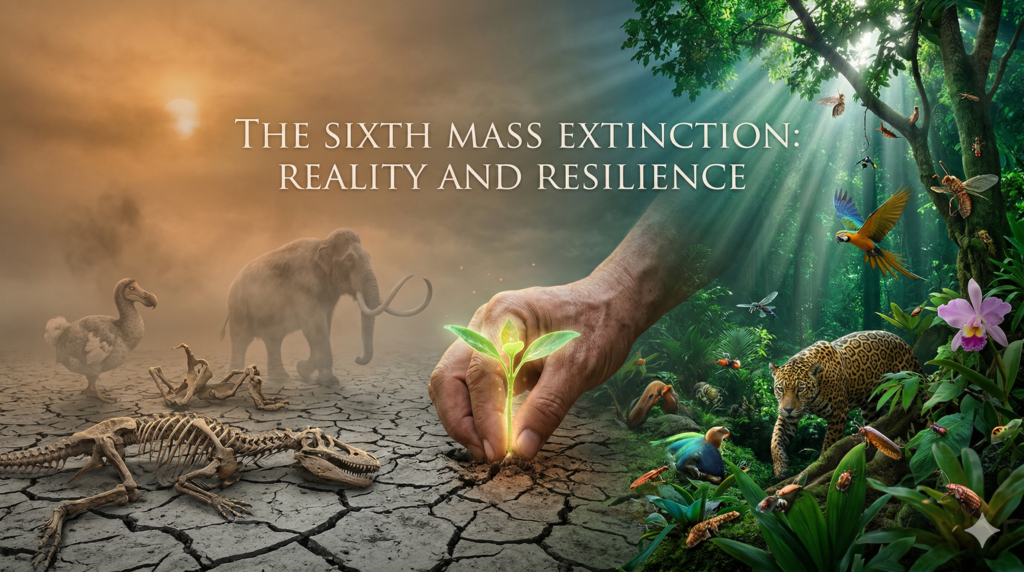
The history of Earth is a story of grand cycles—of ice ages and tropical heat, of rising mountains and shifting continents. But the most dramatic chapters are the “Big Five” mass extinctions, moments in deep time when the pulse of life slowed to a crawl. Today, a growing body of scientific evidence suggests we have entered a new chapter: The Sixth Mass Extinction.
While the previous five were caused by asteroids, volcanic eruptions, or tectonic shifts, this one is unique. It is the first driven by a single species. However, while the reality is sobering, the story isn’t over. This is a look at the data behind the crisis and the incredible resilience of nature that gives us a path forward.
1. The Reality: Beyond the “Background Rate”
Extinction is a natural part of evolution. In normal times, species blink out at what scientists call the “Background Extinction Rate.” Historically, this is roughly one species out of every million per year.
Today, current extinction rates are estimated to be 100 to 1,000 times higher than that background level. We aren’t just losing charismatic megafauna like rhinos or tigers; we are losing the “unseen” foundations of our world—insects, fungi, mollusks, and soil microbes.
The Drivers of the Crisis:
- Habitat Fragmentation: We have carved the wild world into tiny islands surrounded by cities and monoculture farms.
- The Climate Mismatch: Species that have lived in specific temperature bands for millennia are finding their homes shifting faster than they can migrate.
- Overexploitation: The industrial-scale removal of life from our oceans and forests.
- Invasive Species: The global movement of goods has introduced “hitchhiker” species that outcompete and destroy local ecosystems.
2. The “Defaunation” of the Planet
When we talk about extinction, we often focus on the finality of a species disappearing forever. But scientists are equally concerned with “defaunation”—the massive decline in the number of individuals within a species.
A bird species might not be extinct yet, but if its population has dropped by 70%, it can no longer perform its “ecological job.” It stops dispersing seeds; it stops controlling pest populations. This “biological annihilation” weakens the entire web of life, making ecosystems more prone to collapse when faced with a single drought or disease.
3. Resilience: Nature’s Incredible Will to Recover
If the reality is the “doom,” then resilience is the “hope.” Life on Earth has survived the Permian-Triassic extinction, which wiped out 96% of marine species. Life is inherently stubborn.
When we give nature even a small amount of breathing room, the recovery can be breathtaking. This is the concept of “Biological Resilience.” ### Case Study: The Return of the Humpback
In the mid-20th century, the South Atlantic Humpback whale population was decimated by industrial whaling, leaving only about 450 individuals. Many thought they were a “dead species walking.” However, following the 1986 moratorium on commercial whaling, the population surged. Today, there are over 25,000—nearly 93% of their pre-whaling numbers.
Case Study: The Chernobyl Exclusion Zone
Perhaps the most famous example of nature’s resilience is the site of the world’s worst nuclear disaster. In the absence of humans, the Chernobyl Exclusion Zone has become a de facto nature reserve. Wolves, bears, and rare Przewalski’s horses thrive in an environment humans find uninhabitable. It proves that often, the greatest threat to nature is simply our presence, and the greatest gift we can give is space.
4. The Toolkit for the 21st Century
We are no longer just passive observers of nature; we are its guardians. To combat the Sixth Mass Extinction, conservationists are using high-tech and “high-nature” solutions:
- Genetic Rescuing: Using CRISPR and cloning technology to bring genetic diversity back to “bottlenecked” species like the Black-footed ferret.
- Wildlife Corridors: Building bridges and tunnels that allow animals to migrate safely across highways, reconnecting fragmented habitats.
- Indigenous Stewardship: Recognizing that 80% of the world’s remaining biodiversity is found on land managed by Indigenous peoples. Their traditional ecological knowledge is our best defense against further loss.
5. From Anxiety to Action: The Half-Earth Vision
Biologist E.O. Wilson proposed a bold solution: Half-Earth. The idea is that if we can protect 50% of the planet’s land and sea as interconnected nature reserves, we can save 85% of all species.
This might sound impossible, but it starts at the local level. It starts with a city deciding to plant only native trees, a farmer leaving a “wild edge” on his field, and a global community deciding that the value of a living ecosystem outweighs the short-term profit of an oil well.
Final Thoughts
The Sixth Mass Extinction is a mirror. It shows us the impact of our current way of life, but it also reflects our power. We are the first species in the history of the planet that has the awareness to see an extinction coming and the technology to stop it.
The story of the 21st century will either be the story of how we let the web of life unravel, or how we became the species that learned to weave it back together. Nature is resilient; she is waiting for us to give her the chance to heal.
Resilience Tip: Support “Citizen Science.” Apps like iNaturalist allow you to record species in your area. This data helps scientists track migrations and population shifts in real-time, providing the “intel” needed to fight extinction.