
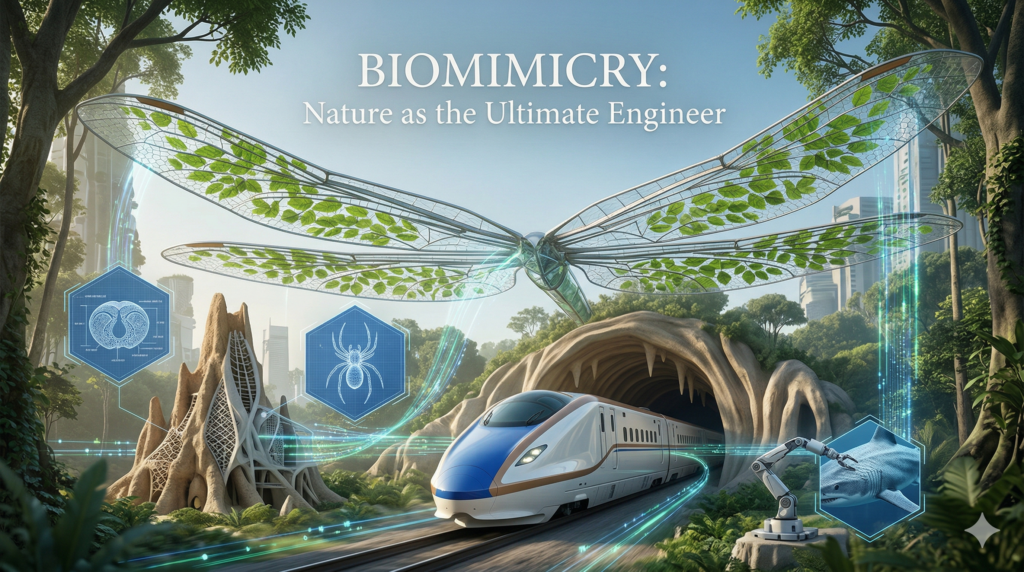
For 3.8 billion years, nature has been running the world’s most rigorous Research and Development laboratory. In this lab, the stakes are ultimate: evolve and solve the problem, or face extinction. The result is a planet filled with high-performance materials, energy-efficient systems, and complex structures that put human engineering to shame.
We are now entering an era where we stop treating nature as a warehouse of raw materials and start treating it as a catalog of brilliant ideas. This is the field of Biomimicry.
1. What is Biomimicry?
Biomimicry (from the Greek bios, meaning life, and mimesis, meaning to imitate) is the practice of looking to nature for inspiration to solve human design challenges. It is not about simply “using” a leaf or a shell in a design; it is about understanding the functional principles behind them.
While traditional human engineering often relies on “heat, beat, and treat”—using massive amounts of energy and toxic chemicals to force materials into shape—nature manufactures at ambient temperatures, uses life-friendly chemistry, and thrives on sunlight. By mimicking these processes, we can create a sustainable future that isn’t just “less bad,” but actually restorative.
2. Masterpieces of Natural Engineering
The Kingfisher and the Shinkansen
One of the most famous examples of biomimicry is the Japanese Shinkansen (Bullet Train). In the 1990s, the train faced a major problem: “tunnel sonic booms.” When the train entered a tunnel at high speeds, the change in air pressure created a thunderous noise that disturbed residents miles away.
The engineering team, led by Eiji Nakatsu—who happened to be an avid birdwatcher—looked to the Kingfisher. This bird can dive from the air into the water with barely a splash, thanks to its unique, wedge-shaped beak. Nakatsu redesigned the nose of the train to mimic the kingfisher’s beak. The result? The train was 10% faster, used 15% less electricity, and—most importantly—became silent.
The Sharkskin Revolution
A shark may look smooth, but its skin is actually covered in millions of microscopic, tooth-like scales called dermal denticles. These denticles serve two incredible purposes: they reduce drag (allowing the shark to swim faster with less energy) and they prevent bacteria from settling on the surface.
Human engineers have copied this texture to create “Sharklet” films for hospital surfaces. Unlike chemical disinfectants that create “superbugs,” this surface uses purely physical geometry to prevent bacteria from colonizing. Additionally, ship hulls coated in shark-inspired textures can save millions of dollars in fuel by reducing drag and preventing barnacle growth without using toxic paints.
Termite Mounds and Passive Cooling
In Zimbabwe, the Eastgate Centre office complex stays cool in the blistering African heat without a traditional air conditioning system. The architect, Mick Pearce, studied termite mounds.
Termites must maintain a precise temperature inside their mounds to grow the fungus they eat. They do this by constantly opening and closing vents at the base and top of the mound, creating a “chimney effect” that draws cool air in and pushes hot air out. By mimicking this passive ventilation system, the Eastgate Centre uses 90% less energy than a conventional building of the same size.
3. The Materials of the Future
Nature doesn’t just design shapes; it creates materials that outperform our best plastics and metals.
- Spider Silk: Gram for gram, spider silk is five times stronger than steel and twice as elastic as nylon. If we could manufacture it at scale (without the spiders, who tend to eat each other), we could create everything from biodegradable surgical sutures to bulletproof vests.
- The Namibian Beetle: This beetle lives in a desert where it almost never rains. It survives by harvesting water from morning fog. Its back is covered in hydrophilic (water-loving) bumps and hydrophobic (water-repelling) valleys. This texture allows it to catch water droplets from the air and funnel them directly into its mouth. Engineers are now copying this to create “fog-catching” nets for drought-stricken communities.
4. Moving from Form to Ecosystem
The “Level 3” of biomimicry is the most ambitious: Ecosystem Mimicry. This isn’t just about making a better wing or a stronger glue; it’s about making a city that functions like a forest.
In a forest, there is no such thing as “waste.” The output of one organism is the input for another. Biomimetic manufacturing seeks to create “Circular Economies” where the heat from a data center warms a nearby greenhouse, and the waste from a brewery becomes the soil for a mushroom farm.
When we engineer like nature, we move toward a world where our very presence on the planet helps it thrive. Imagine a pavement that absorbs $CO_2$ like a coral reef, or a rooftop that filters water like a wetland.
5. Why Biomimicry Matters Now
We are currently facing global crises—climate change, plastic pollution, and resource scarcity—that our traditional engineering methods cannot solve. We have run out of “away” to throw things.
Biomimicry offers a path forward that is already proven. Nature has already solved the problems of energy storage, carbon sequestration, and non-toxic manufacturing. We don’t need to reinvent the wheel; we just need to look at how the beetle, the bird, and the banyan tree have been doing it for millions of years.
Final Thoughts
The next time you look at a leaf, don’t just see a piece of greenery. See a solar panel that is 100% recyclable. Look at a seashell and see a ceramic tougher than anything we can bake in a kiln. Biomimicry teaches us a much-needed lesson in humility: we are not the masters of nature, but its students.
The ultimate engineer isn’t a person in a lab coat; it’s the quiet, persistent force of evolution that surrounds us every time we step outside.
Engineer’s Insight: In nature, “design” is a verb, not just a noun. It is a constant process of adaptation. To truly mimic nature, our technology must also become more adaptive, modular, and resilient.