
When we talk about “nature,” our minds typically drift to sun-drenched meadows, vibrant coral reefs, or the deep greens of a rainforest. We think of nature as something that happens under the light of the sun. But when the sun dips below the horizon, we don’t lose nature—we simply enter the other half of it.
The nocturnal world is a vast, intricate, and increasingly fragile ecosystem. Yet, for the first time in evolutionary history, this half of nature is disappearing. Due to the rapid spread of artificial light, we are living through the era of the “End of Night,” and the consequences for wildlife and human health are profound.
1. The Biological Clock: Nature’s Rhythm
For billions of years, life on Earth has evolved under a reliable, rhythmic pulse: the cycle of light and dark. This cycle is hardwired into the DNA of almost every living organism through circadian rhythms. These internal clocks tell flowers when to bloom, birds when to migrate, and humans when to sleep.
In the natural world, the dark is not a void; it is a resource. It provides the cover of night for predators to hunt, the coolness for desert animals to move, and the celestial cues for navigation. When we flood the night with artificial light—a phenomenon known as Light Pollution—we aren’t just losing our view of the stars; we are breaking the biological rhythm of the planet.
2. The Ecological Toll of Permanent Day
More than half of the world’s species are nocturnal. For them, artificial light at night (ALAN) is not a convenience; it is a pollutant that disrupts their most basic survival instincts.
The Great Migration Disruption
Many bird species migrate at night, using the stars and the moon to navigate across continents. Brightly lit cities and glass skyscrapers act like sirens, drawing birds off-course. Disoriented by the glare, millions of birds die every year from exhaustion or collisions with buildings.
The Sea Turtle’s Long Journey
Perhaps the most heartbreaking example of light pollution occurs on our beaches. Sea turtle hatchlings emerge from their nests at night and have an instinct to crawl toward the brightest horizon—which, for millions of years, was the reflection of the moon on the ocean. Today, the glow of streetlights and hotels often lures them inland toward roads and predators, leading to a devastating loss of the next generation.
The Silent Pollinators
We often credit bees and butterflies for our food security, but moths and other nocturnal insects do a massive amount of the heavy lifting. Artificial lights act as “vacuum cleaners” for insects, attracting them until they die of exhaustion or are picked off by predators. This collapse of the nocturnal insect population ripples up the food chain, affecting bats, birds, and even the plants that rely on them for pollination.
3. Human Health and the Loss of Melatonin
Humans are not immune to the loss of the dark. Our bodies are designed to produce melatonin—a hormone often called the “Dracula of hormones” because it only comes out in the dark. Melatonin does more than help us sleep; it is a powerful antioxidant that regulates our immune system and suppresses the growth of certain tumors.
By surrounding ourselves with “blue light” from LEDs, streetlamps, and screens late into the night, we trick our brains into thinking it is still daytime. This chronic suppression of melatonin has been linked by the American Medical Association to increased risks of obesity, diabetes, depression, and even certain types of cancer. We are, quite literally, making ourselves sick by fearing the dark.
4. The Cultural Loss: Our Connection to the Cosmos
Beyond the biological and ecological impact, there is a spiritual loss that is harder to quantify. Throughout history, the night sky was our first library, our first map, and our first temple. It inspired the mythologies of every culture, the mathematics of the Greeks, and the poetry of the Romantic era.
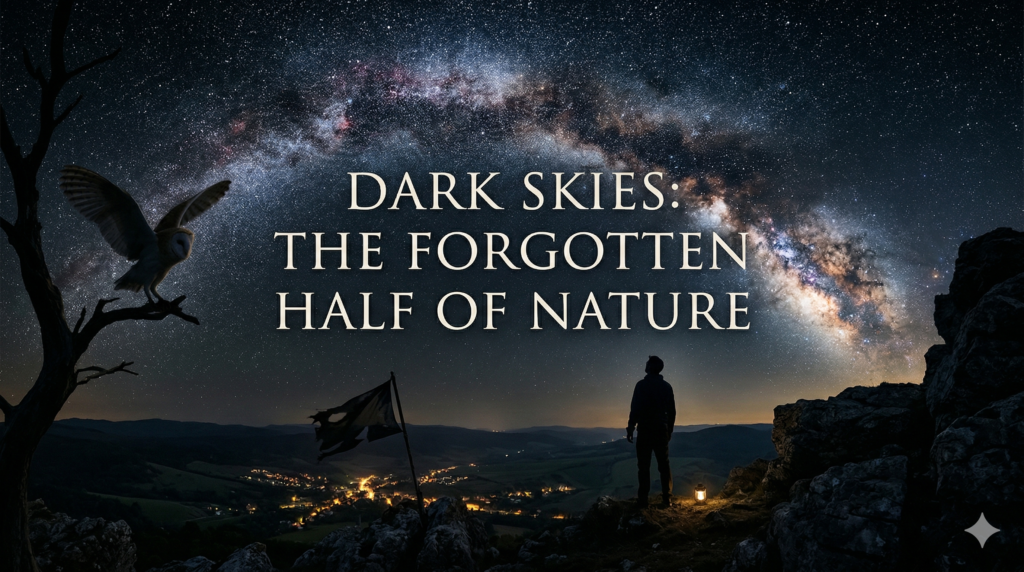
Today, 80% of North Americans can no longer see the Milky Way from where they live. We have become a “walled-in” species, disconnected from the vastness of the universe. When children grow up without seeing the stars, they lose a fundamental sense of perspective—the humbling realization that we are part of something much larger than our own small planet.
5. The Solution: Lighting for the Future
The beauty of light pollution is that, unlike plastic in the ocean or carbon in the atmosphere, it is instantly reversible. We can bring back the dark with the flip of a switch. Sustainable lighting doesn’t mean living in total darkness; it means using “Dark Sky-Friendly” practices:
- Shielding: Ensuring light fixtures point downward, illuminating the ground rather than the sky.
- Warmth: Using “warm” amber-toned LEDs (under 3000 Kelvin) which are less disruptive to wildlife than harsh blue-white lights.
- Timing: Using motion sensors or timers so lights are only on when they are actually needed.
- Preservation: Supporting International Dark Sky Places—parks and reserves that are committed to protecting the integrity of the night.
Final Thoughts
Darkness is not the enemy of light; it is the partner of life. To protect nature is to protect the night. By reclaiming the “forgotten half” of our world, we allow the turtles to find the sea, the birds to find their way home, and ourselves to find our place among the stars once again.
The next time you are outside after dusk, resist the urge to turn on a flashlight immediately. Let your eyes adjust. Listen to the symphony of the nocturnal world. Remember that the dark is just as beautiful, and just as necessary, as the light.
Night Sky Challenge: Look up tonight. How many stars can you count? If the answer is “not many,” consider talking to your local community about “Dark Sky” lighting. We can bring the Milky Way back to our backyards.