
In an age where food is often shrink-wrapped in plastic, barcodes are our primary connection to nutrition, and supply chains span continents, there is something deeply revolutionary about stepping into the wild and plucking your dinner directly from the earth. Foraging—the ancient practice of searching for and harvesting wild food—is seeing a massive global resurgence. It is fueled by a desire for organic nutrients, food sovereignty, and a desperate psychological need to reconnect with the landscape.
However, as foraging moves from a niche survival skill to a mainstream hobby, the pressure on our wild spaces has intensified. To forage truly sustainably, we must move beyond the mindset of a “consumer” and become a “steward.” This is the core of The Ethics of Eating Wild.
1. The Philosophy of the Honorable Harvest
Indigenous cultures have practiced sustainable foraging for millennia, guided by principles that the modern “foraging influencer” often overlooks. The Honorable Harvest, a concept beautifully articulated by botanist Robin Wall Kimmerer, suggests that we should treat the land not as a pharmacy or a grocery store, but as a neighborhood of living beings.
The most vital rule of the Honorable Harvest is simple: Never take the first one you see. If you find a patch of wild ramps or a cluster of chanterelles, the first one belongs to the land. By waiting until you find a healthy, abundant population, you ensure that you aren’t harvesting the last of a struggling colony.
The Golden Rule of Thirds:
A common ethical framework among experienced foragers is the rule of thirds:
- One third for the wildlife (birds, insects, and mammals) that depends on that plant.
- One third for the plant itself to go to seed and reproduce.
- One third for the forager.
If a patch cannot sustain this division, it is too small to harvest.
2. Knowing the Difference: Invasives vs. Rarities
Sustainable foraging requires a high level of botanical literacy. You must be able to distinguish between invasive species, opportunistic weeds, and native rarities.
The Green Light: Eating the Invasives
If you are a beginner, the most ethical way to start is by foraging invasive species. Plants like Garlic Mustard, Japanese Knotweed, and Common Dandelion are often ecological bullies that crowd out native flora. In these cases, your appetite is a conservation tool. By harvesting Garlic Mustard for pesto, you are helping native wildflowers reclaim their space.
The Red Light: At-Risk Natives
Some plants are so slow-growing that any harvest is a threat to their survival. American Ginseng and Wild Ramps (Leeks) are prime examples. A ramp patch can take seven years to reach maturity. If you harvest the bulb (the root), that plant is gone forever. Ethical foragers will only take a single leaf from a plant, leaving the bulb in the ground to continue growing and flowering.
3. The Ethics of “Where”: Geography and Safety
Where you forage is just as important as what you pick. Ethical foraging involves respecting both the environment and the law.
- Legal Boundaries: Many national and state parks prohibit foraging to protect the ecosystem from heavy foot traffic. Always check local regulations; “poaching” plants from protected areas damages the reputation of the foraging community.
- Chemical Runoff: Ethics also involve self-care. Foraging near busy roads, old industrial sites, or chemically treated golf courses is dangerous. Plants are bio-accumulators; they soak up heavy metals (like lead from old gas) and pesticides from the soil.
- Private Property: Always seek permission. Building a relationship with a local landowner is the best way to find “clean” foraging spots while respecting human boundaries.
4. The Hidden Impact: Soil and Wildlife
Foraging is not just about the plant; it’s about the footprint you leave behind.
Soil Compaction: Off-trail hiking to find that “secret patch” of mushrooms can compact the soil, crushing the delicate mycelium networks (the “Wood Wide Web”) that trees rely on. Sustainable foragers use “stealth” techniques—varying their paths and wearing soft-soled shoes to minimize the physical impact on the earth.
Wildlife Competition:
We must remember that for us, a wild berry is a gourmet snack; for a bear or a migratory bird, it is the difference between surviving the winter and starvation. If you notice signs of heavy animal feeding in an area, move on. The forest’s permanent residents always have the right of first refusal.
5. Proper Technique: The Forager’s Toolkit
How you harvest determines if the plant will return next year.
- Use a Knife: Instead of pulling plants up by the roots, use a sharp knife to cut them at the base. This keeps the root system and the soil structure intact.
- Mesh Bags for Mushrooms: When foraging for fungi, use a mesh bag rather than a plastic or paper one. As you walk through the woods, the mesh allows spores to fall through the holes, essentially “re-seeding” the forest as you move.
- Sanitation: Ensure your tools are clean. Fungal diseases and invasive seeds can easily be hitched on dirty boots or knives, spreading pathogens from one forest to another.
6. From Extraction to Reciprocity
The ultimate goal of ethical foraging is to shift from an extractive relationship with nature to a reciprocal one. If you take from a patch of berries, perhaps you return in the summer to pull the invasive vines that are choking the bushes. If you harvest wild seeds, perhaps you scatter some in a nearby area with similar conditions to help the species expand.
When you forage ethically, you stop seeing “the woods” as a green backdrop and start seeing it as a collection of individuals with names, histories, and needs. This connection is the greatest health benefit foraging provides—greater than any vitamin found in a wild nettle.
Final Thoughts: The Slow Food Revolution
Sustainable foraging is a slow, meditative practice. It is the antithesis of “fast food” culture. It requires patience, years of study, and a profound respect for the limits of the natural world. By following the ethics of the honorable harvest, we ensure that the wild pantry remains stocked for the generations of humans—and animals—that come after us.
Forager’s Creed: Take only what you need, use everything you take, and leave the land better than you found it.
Header Image Prompt
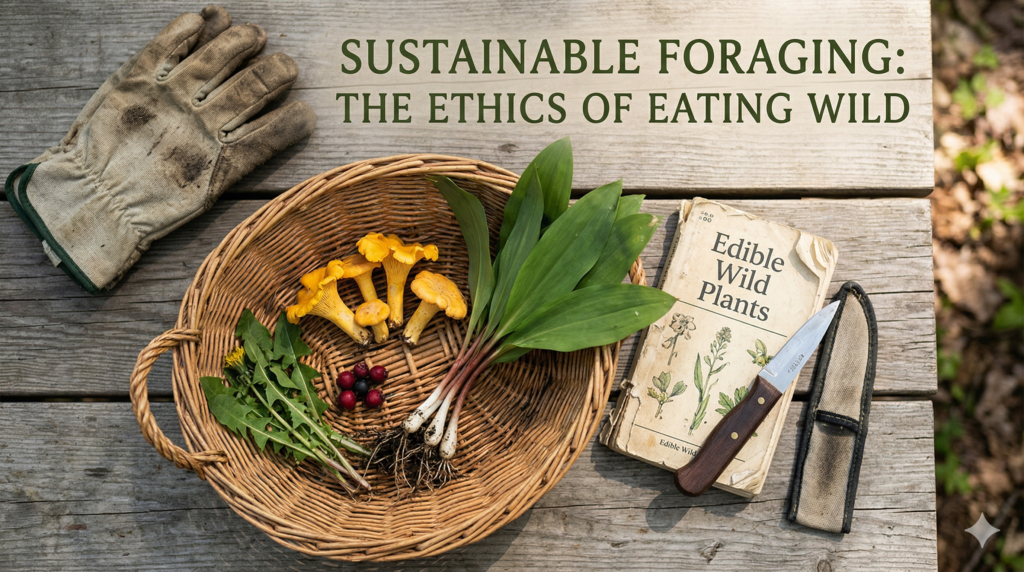
Prompt: A high-resolution, rustic “flat lay” photograph on a weathered wooden table. In the center, a hand-woven wicker basket contains a modest, colorful collection of wild-foraged items: three chanterelle mushrooms, a small bunch of wild ramps with green leaves, and several bright yellow dandelions. Next to the basket sits a small, sharp forging knife with a dark wooden handle, a tattered field guide book with botanical sketches, and a pair of canvas gardening gloves. The lighting is warm and natural, coming from a nearby window, evoking a sense of respect, craft, and connection to the earth. Title overlay: SUSTAINABLE FORAGING: The Ethics of Eating Wild.