
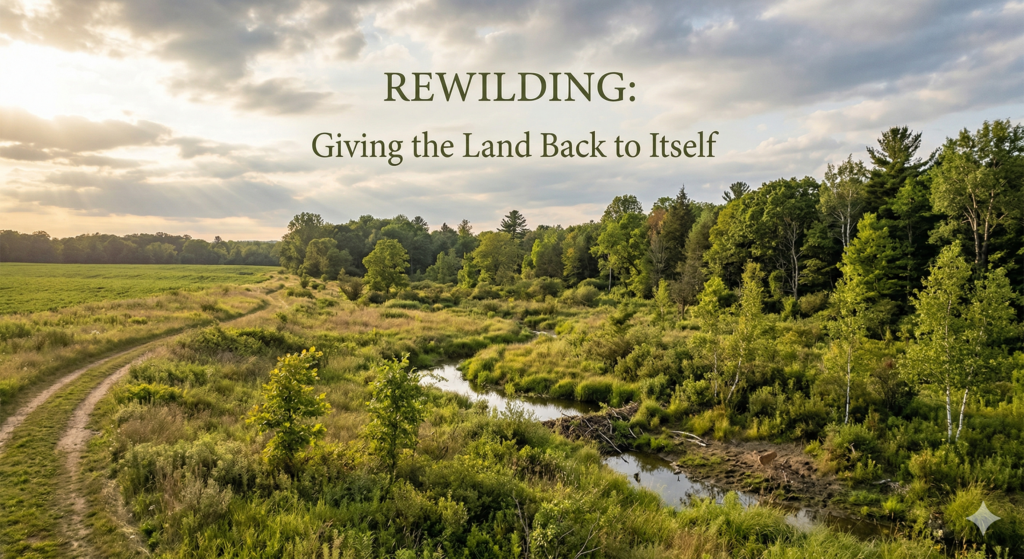
For centuries, the human relationship with nature has been defined by one word: dominion. We have dammed rivers, fenced off forests, manicured grasslands into monoculture lawns, and paved over wetlands. We viewed the earth as a resource to be managed, a garden to be weeded, or a wild beast to be tamed.
But as we face the dual crises of climate change and mass biodiversity loss, a radical new philosophy is taking root. It’s called rewilding. Unlike traditional conservation, which often focuses on protecting a specific species or “freezing” a landscape in a particular historical state, rewilding is about stepping back. It is the act of giving the land back to itself and letting nature take the lead.
What is Rewilding, Really?
At its core, rewilding is a form of environmental restoration that aims to restore natural processes and wilderness areas. The goal isn’t to reach a specific aesthetic end-point, but to reinstate a self-regulating ecosystem.
Think of it as re-starting the engine of nature. When an ecosystem is healthy, it doesn’t need us to plant every tree or manage every population. It has its own checks and balances. Rewilding focuses on three main pillars, often referred to as the 3 C’s:
- Cores: Large, strictly protected areas where nature can thrive without human interference.
- Corridors: Connections between these core areas, allowing wildlife to migrate, disperse, and find mates.
- Carnivores (and Keystone Species): The reintroduction of animals that play a disproportionate role in maintaining the health of their environment.
The Power of Keystone Species: The Yellowstone Example
You cannot talk about rewilding without talking about the wolves of Yellowstone National Park. In the mid-1990s, gray wolves were reintroduced to the park after a 70-year absence. What followed was a “trophic cascade”—a side-effect of a change in the food chain that transformed the entire geography of the park.
- The Problem: Without wolves, elk populations had exploded, overgrazing young aspen and willow trees. This led to soil erosion and a lack of habitat for birds and beavers.
- The Solution: The wolves didn’t just eat the elk; they changed the elk’s behavior. Elk began avoiding valleys and gorges where they were easily hunted.
- The Result: In those avoided areas, vegetation regenerated. Trees grew taller. Birds returned. Beavers used the new wood to build dams, which created ponds that became habitats for otters, muskrats, and fish. Even the physical flow of the rivers changed because the new vegetation stabilized the banks.
This is the essence of rewilding. By introducing one key player, the land began to heal itself in ways humans never could have engineered with a shovel and a blueprint.
Beyond the Big Predators: Ecosystem Engineers
While wolves and bears grab the headlines, rewilding often relies on humbler “engineers.”
The Busy Beaver
Beavers are perhaps the greatest rewilders on the planet. By building dams, they create “leaky” landscapes. These wetlands act as natural sponges, filtering water, sequestering carbon, and—crucially in our warming world—providing natural firebreaks and drought protection.
The Wild Herbivores
In Europe, projects like Oostvaardersplassen in the Netherlands or Knepp Wildland in England have used “proxies” for extinct ancient herbivores. By introducing hardy breeds of cattle (like Longhorns) and ponies (like Exmoors) to mimic the ancient Aurochs and Tarpan, land managers have seen a transformation. These animals disturb the soil with their hooves and create a mosaic of scrub, grassland, and woodland, which supports a far higher diversity of life than a neatly planted forest ever could.
Why Rewilding Matters Now
We are currently living through the “Sixth Mass Extinction.” According to recent reports, wildlife populations have plummeted by an average of 69% since 1970. Traditional conservation—keeping small islands of nature surrounded by a sea of concrete—is no longer enough.
1. Carbon Sequestration
Nature is our best technology for capturing carbon. Wild, “messy” ecosystems—rich in peatlands, old-growth forests, and diverse grasslands—store significantly more carbon than monoculture timber plantations. Rewilding allows these natural carbon sinks to expand and thicken.
2. Climate Resilience
As extreme weather becomes the norm, rewilded landscapes offer a buffer. Mangroves and salt marshes protect coasts from storm surges. Reconnected floodplains give rivers room to breathe, preventing catastrophic flooding in downstream towns.
3. Human Well-being
There is a growing body of evidence that “wild” spaces—not just parks, but truly biodiverse areas—are essential for human mental health. Rewilding offers us a chance to reconnect with a sense of wonder and realize that we are part of a larger, living system.
The Challenges: Can We Coexist?
Rewilding isn’t without its critics. One of the primary tensions lies in land use. Farmers often fear that rewilding projects will lead to livestock predation or the loss of productive agricultural land. There is also the cultural fear of “abandonment”—the idea that if we aren’t managing the land, we are failing it.
To be successful, rewilding must be a social process as much as a biological one. It requires:
- Compensation: Supporting farmers who transition from traditional agriculture to nature restoration.
- Nature-Based Economies: Developing ecotourism and sustainable harvesting that provide jobs for local communities.
- Communication: Moving away from the “humans vs. nature” narrative and toward a “humans within nature” perspective.
Rewilding Your Own Backyard
You don’t need a thousand-acre estate to participate in this movement. The philosophy of “giving the land back to itself” can happen at any scale.
| Scale | Action |
| The Garden | Stop using pesticides. Leave a corner of the lawn to grow long. Plant native wildflowers for pollinators. |
| The Neighborhood | Advocate for “wild corridors” in local parks. Encourage the planting of native trees over ornamental ones. |
| The Community | Support local land trusts and organizations working to remove dams or restore local wetlands. |
A Vision for the Future
Imagine a future where our cities are interspersed with wild corridors. Imagine a world where the roar of a river isn’t muffled by concrete, and the return of a species isn’t a miracle, but a regular occurrence.
Rewilding is an act of radical hope. It is an admission that we don’t have all the answers and a gesture of trust in the Earth’s innate ability to heal. It’s time we stopped trying to be the gardeners of the planet and started being its partners. By stepping back and giving the land back to itself, we might just find that we are saving ourselves in the process.
The wild isn’t something that’s gone; it’s something that’s waiting. We just need to move the fences.