
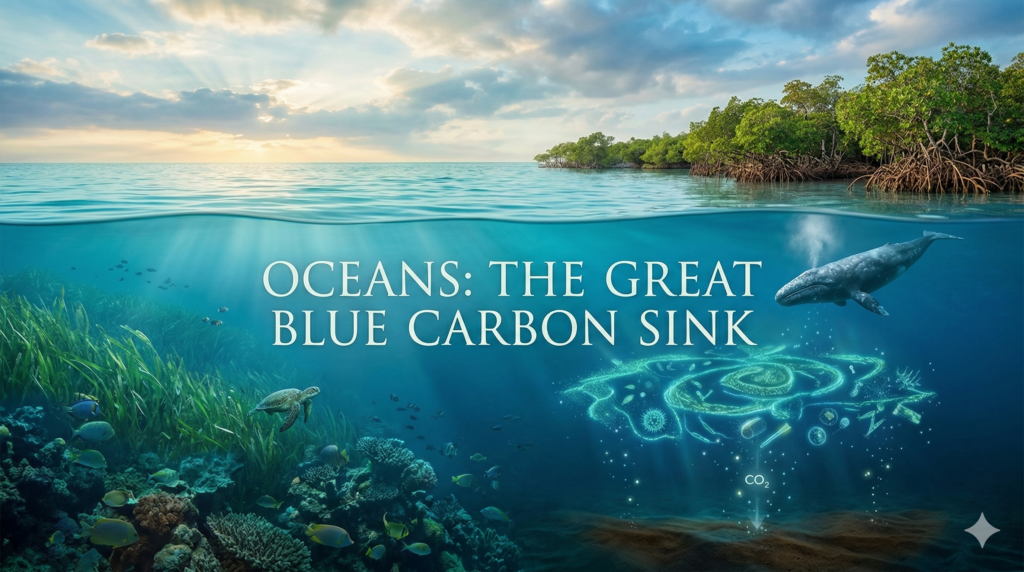
While we often look to the vast Amazon or the sprawling taiga of Siberia as the “lungs of our planet,” the true engine of Earth’s climate stability is draped in shades of cerulean and indigo. Our oceans cover over 70% of the Earth’s surface, and beneath their waves lies the most effective carbon management system ever devised by nature.
This is the world of Blue Carbon, and understanding it is vital for our survival in a warming world.
What is Blue Carbon?
Blue carbon refers to the carbon dioxide ($CO_2$) captured from the atmosphere by the world’s ocean and coastal ecosystems. While terrestrial forests are famous for storing carbon in their wood and leaves, marine ecosystems are the quiet overachievers. They don’t just store carbon in their living biomass; they bury it deep within the underwater soil, where it can remain sequestered for millennia.
When we talk about the “Great Blue Carbon Sink,” we are primarily looking at three powerhouse ecosystems: Mangroves, Seagrass Meadows, and Salt Marshes. Despite covering less than 0.5% of the sea floor, these coastal habitats are responsible for nearly 50% of the carbon sequestered in ocean sediments.
The Coastal Guardians: Mangroves and Seagrass
1. Mangroves: The Roots of Resilience
Mangroves are the only trees capable of thriving in saltwater. Their tangled, “walking” roots act as a massive trap for organic matter. As leaves and branches fall into the brackish water, they are quickly buried in oxygen-poor (anaerobic) mud. Because there is little oxygen, the organic matter decomposes incredibly slowly.
Studies show that a square mile of mangrove forest can store as much as ten times the carbon of a square mile of tropical rainforest. They are vertical carbon vaults, holding centuries of greenhouse gases beneath their roots.
2. Seagrass Meadows: The Underwater Prairies
If mangroves are the vaults, seagrasses are the lungs. These flowering plants form vast meadows in shallow coastal waters. Not only do they provide nurseries for 20% of the world’s largest fisheries, but they are also incredibly efficient at capturing carbon.
Seagrasses can store up to twice as much carbon per square mile as terrestrial forests. Because the sediment they grow in is constantly being added to, the “sink” grows deeper over time. Some seagrass beds have been found to hold carbon deposits that are over 6,000 years old.
The Biological Pump: Phytoplankton and Whales
Beyond the coast, the open ocean plays its part through what scientists call the Biological Pump.
At the surface, trillions of microscopic organisms called phytoplankton perform photosynthesis, absorbing $CO_2$ and releasing oxygen. In fact, phytoplankton are responsible for every second breath you take. When these organisms die, they sink to the “midnight zone” of the ocean. This “marine snow”—a mix of dead plankton, waste, and organic detritus—drifts to the abyssal plains, effectively locking carbon away from the atmosphere for centuries.
Interestingly, even the great whales are part of this sink. A single great whale can sequester an average of 33 tons of $CO_2$ during its lifetime. When a whale dies and sinks to the bottom (a “whale fall”), that carbon is removed from the atmospheric cycle for a vast stretch of time.
The Crisis: A Sink Under Pressure
Unfortunately, our great blue carbon sink is in trouble. We are currently losing these ecosystems at an alarming rate—up to four times faster than terrestrial forests.
1. Ocean Acidification
As the ocean absorbs more $CO_2$ (it has absorbed about 30% of human-emitted $CO_2$ since the Industrial Revolution), the water becomes more acidic. This makes it harder for calcifying organisms, like corals and certain plankton, to build their shells. If the base of the food chain collapses, the biological pump slows down.
2. Habitat Destruction
Coastal development, shrimp farming, and pollution are wiping out mangroves and seagrasses. When these ecosystems are destroyed, they don’t just stop sequestering carbon; they release the thousands of years of stored carbon back into the atmosphere. A destroyed mangrove forest becomes a “carbon bomb.”
3. Rising Temperatures
Warming waters hold less oxygen and can disrupt the currents that move nutrients and carbon through the deep sea. Marine heatwaves are also responsible for mass “die-offs” of seagrass and kelp forests.
Restoring the Blue
The good news is that “Blue Carbon” has become a focal point for international climate policy. Restoring these habitats offers a “triple win”:
- Climate Mitigation: Actively pulling $CO_2$ out of the air.
- Coastal Protection: Mangroves and marshes act as natural buffers against storm surges and rising sea levels.
- Biodiversity: Restoring these areas brings back fish, birds, and marine life, supporting local economies.
Countries are now beginning to include seagrass and mangrove restoration in their climate targets. This is not just about “saving the whales”—it is about maintaining the very chemistry of our atmosphere.
Final Thoughts
The ocean has been our silent partner in the fight against climate change, absorbing the heat and the gas we’ve produced for over a century. But even the vastness of the sea has its limits. Protecting the Great Blue Carbon Sink is no longer an optional environmental project; it is a global necessity.
By protecting our coastlines and reducing our plastic and chemical footprints, we give the ocean the space it needs to do what it does best: sustain life on Earth.
Did You Know? A single acre of seagrass can produce over 100,000 liters of oxygen per day. Protecting these meadows is literally a matter of life and breath.