
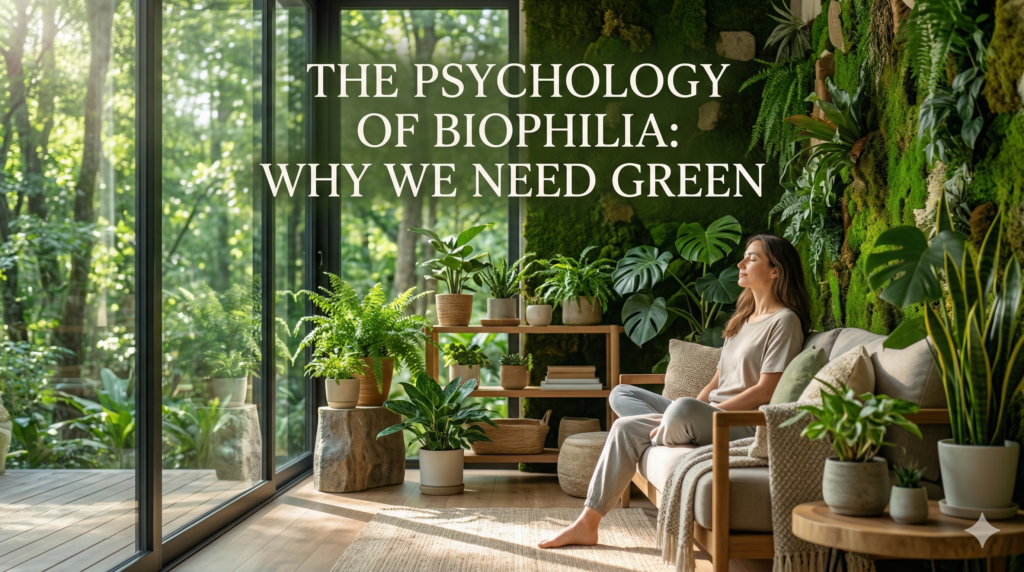
Have you ever noticed how a simple walk in the park can clear a mental fog that hours of scrolling through your phone couldn’t touch? Or why we feel a strange sense of peace when we sit by a window overlooking a garden? This isn’t just a coincidence; it is a fundamental biological requirement. Scientists call this Biophilia, and it is the key to understanding our deep-seated psychological need for the natural world.
The Evolutionary Roots of Calm
The term “biophilia” was popularized by biologist E.O. Wilson in the 1980s. He hypothesized that humans possess an innate tendency to seek connections with nature and other forms of life. From an evolutionary perspective, this makes perfect sense. For 99% of human history, our survival depended on our ability to read the landscape. We are biologically hardwired to feel at ease in environments that signal life: lush greenery (indicating water and food), open vistas (safety from predators), and the presence of diverse flora.
Today, we live in a “mismatch” environment. Our brains are still calibrated for the savannah, yet we spend roughly 90% of our time indoors under artificial lights and surrounded by concrete. The psychology of biophilia suggests that our modern mental health crisis—marked by rising levels of anxiety and depression—is, in part, a symptom of our separation from the “green” world.
The Science: Cortisol and Fractals
When we step into nature, our physiology undergoes a rapid shift. Studies on Shinrin-yoku, or Japanese “forest bathing,” have shown that spending time in a forest significantly lowers levels of cortisol, the body’s primary stress hormone. But why?
Part of the answer lies in fractals. Fractals are complex geometric patterns that repeat at every scale—think of the branching of a tree, the veins in a leaf, or the spirals of a seashell. Human eyes have evolved to process these specific patterns with incredible ease. When we look at nature’s fractals, our brains produce alpha waves, which are associated with a relaxed but alert state. In contrast, the sharp angles and blank surfaces of modern urban architecture require more cognitive effort to process, leading to “directed attention fatigue.”
Nature as a Cognitive Reset
Our modern lives demand constant, focused attention. Whether it’s responding to emails or navigating traffic, our “attentional filters” are constantly working overtime. According to Attention Restoration Theory (ART), nature provides a period of “soft fascination.”
In a natural setting, your mind can wander. You notice the rustle of leaves or the pattern of clouds without having to make a decision or solve a problem. This “soft fascination” allows our cognitive resources to recharge. Research from the University of Melbourne found that even looking at a grassy “green roof” for just 40 seconds significantly boosted participants’ concentration levels on subsequent tasks compared to those who looked at a concrete roof.
Bringing the Outside In
The good news is that you don’t need to move to the wilderness to benefit from biophilia. Biophilic design is an emerging trend in architecture and interior design aimed at re-integrating nature into our daily lives. This can include:
- Physical Presence: Adding indoor plants, living walls, or water features.
- Natural Analogues: Using organic materials like wood and stone, or patterns that mimic nature.
- Sensory Connection: Maximizing natural light and allowing for fresh air circulation.
Even small changes, like placing a plant on your desk or choosing a landscape photo as your computer wallpaper, can provide a micro-dose of the psychological benefits that nature offers.
Final Thoughts
We often treat nature as a luxury—a place we visit on vacation or a weekend treat. But the psychology of biophilia tells us that nature is a necessity. We are not separate from the environment; we are a part of it. By making “green” a priority in our homes, workplaces, and cities, we aren’t just decorating—we are feeding a hungry part of our ancient, biological selves.
Mental Health Tip: If you’re feeling overwhelmed, try the “20-minute rule.” Research suggests that just 20 minutes of sitting or walking in a place that makes you feel connected to nature is enough to significantly lower your stress hormone levels.
Header Image Prompt
Prompt: A split-screen style cinematic image. On the left side, a dull, gray, sterile modern office with harsh fluorescent lighting. On the right side, the office dissolves into a lush, vibrant forest sanctuary with sunlight streaming through leaves, indoor ferns growing from the desks, and a soft mossy floor. In the center, a person sits in a state of deep peace, eyes closed, with glowing green “fractal” energy patterns subtly radiating from them. High resolution, photorealistic, calm and healing atmosphere. Title overlay: THE PSYCHOLOGY OF BIOPHILIA: Why We Need Green.