
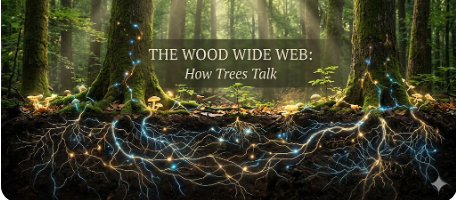
Beneath the damp soil of a quiet forest floor, a conversation is happening that rivals the complexity of our own internet. While trees may seem like solitary giants, standing in stoic silence, they are actually part of a massive, social, and incredibly sophisticated network. Scientists call this the “Wood Wide Web,” and it is changing everything we thought we knew about the natural world.
The Mycelial Superhighway
At the heart of this communication network are mycorrhizal fungi. These fungi grow in a symbiotic relationship with tree roots. The fungi provide the trees with essential nutrients like phosphorus and nitrogen, which they extract from the soil more efficiently than roots can. In exchange, the trees provide the fungi with sugar, a byproduct of photosynthesis.
However, the relationship goes much deeper than a simple trade. These fungal threads, or hyphae, connect individual trees to one another, creating a sprawling subterranean grid. Through this grid, trees don’t just share nutrients—they share information.
A Community of Support
One of the most profound discoveries in forest ecology is that trees are not always competing for resources; often, they are cooperating. Suzanne Simard, a pioneer in this field, discovered that “Mother Trees”—the largest, oldest trees in the forest—use this fungal network to identify their own kin. When a sapling is struggling in the shade of the canopy, the Mother Tree will actually send it excess sugar and nutrients to ensure its survival.
This isn’t limited to family members, either. In a healthy forest, different species will support each other during different seasons. For instance, paper birch trees have been observed sending carbon to Douglas fir trees when the firs are shaded, and vice versa when the seasons shift. It is a biological social security system that ensures the resilience of the entire ecosystem.
The Alarm System
The Wood Wide Web also functions as an early warning system. When a tree is attacked by beetles or aphids, it releases chemical signals into the fungal network. Neighboring trees receive these “data packets” and begin boosting their own immune systems, producing bitter chemicals to repel the incoming pests before they even arrive.
This communication happens through:
- Chemical signaling: Hormones and compounds sent through the fungal threads.
- Electrical impulses: Rapid signals similar to the animal nervous system.
Why the Wood Wide Web Matters
Understanding this network changes how we view conservation. When we clear-cut a forest or even remove a single “Mother Tree,” we aren’t just removing a piece of timber; we are severing the vital links of a community. Without the network, the remaining trees become more vulnerable to disease, drought, and wind.
Moreover, the Wood Wide Web is a massive carbon sink. The fungi lock carbon into the soil, keeping it out of the atmosphere. Protecting these networks is just as important for the climate as protecting the trees themselves.
Final Thoughts
The next time you walk through a forest, try to visualize the bustling activity beneath your boots. Every step you take is above a highway of information, a hidden world where trees look out for one another and collaborate for the greater good. The Wood Wide Web teaches us that in nature—as in human society—the secret to strength isn’t just standing tall; it’s staying connected.